

Components 1 is getting into a brand new period in 2026 due to its regulation overhaul, which is arguably the most important within the championship’s historical past with modifications to each the chassis and energy unit.
An F1 chassis is now roughly 32kg lighter with considerably much less downforce, whereas the engine is extra reliant on electrical vitality with a near-50:50 break up towards the interior combustion engine.
There are a number of different modifications as nicely which got here to mild throughout pre-season testing in Barcelona and Bahrain, so right here is among the jargon that ought to come up in the course of the early rounds of 2026.
Lively aerodynamics
For 14 years, F1 had the Drag Discount System – extra generally generally known as DRS – which noticed the rear wing flaps open when inside one second of the automotive in entrance to help overtaking. Now, nevertheless, these lively aerodynamics apply to each the entrance and rear wings and are break up into both ‘straight mode’ or ‘nook mode’.
In ‘straight mode’, each units of wings will open, shifting to a decrease angle of assault to scale back drag, and the entrance wing is now becoming a member of the rear on this to offer higher stability. However as soon as a driver lifts off for a nook, the wings will return to their higher-downforce state, that means they can’t be open for a flip.
That is totally different to DRS although, as a result of whereas that might solely be used inside one second of the automotive in entrance, drivers can use ‘straight mode’ and ‘nook mode’ all through a grand prix, and every circuit may have designated zones the place ‘straight mode’ can be utilized, with ‘nook mode’ in each different location.
Flat flooring
Within the final regulation period, F1 had ground-effect automobiles from 2022 to 2025, and one of many distinctive options was the ground because it featured a venturi tunnel, which accelerated airflow to create low strain. For 2026 although, F1 is returning to the flat flooring it used till then, and they’re a a lot less complicated design which produces far much less downforce.
Overtake mode
Liam Lawson, Racing Bulls leads Isack Hadjar, Pink Bull Racing
Picture by: Andy Hone / LAT Photographs through Getty Photographs
The efficient substitute for DRS is definitely ‘overtake mode’, which may solely be used when inside one second of the automotive in entrance and in designated zones on the circuit. It’s successfully a push-to-pass button, protecting the automotive at a most 350kW for longer.
Increase mode
‘Increase mode’ is a guide button on the steering wheel which triggers a brand new energy unit setting. The setting might both be a personalised one created by the crew, or one which provides drivers use of the additional battery energy they’ve harvested with the vitality restoration system. In contrast to ‘overtake mode’, this can be utilized when attacking or defending.
Recharge
That is largely the contentious a part of the 2026 laws, as a result of it merely refers to drivers recharging their battery to have enough energy saved all through the lap. Now that the ability unit is extra reliant on electrical vitality, recharging the battery will play a larger function in grands prix, and Max Verstappen referred to as the brand new F1 “Components E on steroids”.
One of many causes for him saying it’s because a solution to recharge the battery can be to downshift alongside a straight or carry and coast right into a nook, and though this goes towards every thing the drivers have been beforehand taught, it might be needed for a greater general lap time.
On account of this, it’s going to see every circuit on the calendar be categorised as both ‘energy-rich’ or ‘energy-poor’. The energy-rich tracks are the place recharging the battery can be comparatively straightforward, primarily attributable to their low-speed nature, whereas it’s the other for energy-poor circuits similar to Monza.
Superclipping
‘Superclipping’ got here up a good quantity throughout Bahrain testing and it refers to how the automobiles can harvest vitality whereas the driving force remains to be at full throttle, normally on the finish of a straight or in high-speed corners. This happens when the MGU-Okay is put into harvest mode and harvests the ability that will normally go to the rear wheels to reserve it for deployment later within the lap – although it does end in a velocity discount.
Beneath the 2026 laws, the vitality that may be harvested through superclipping is at the moment restricted to 250kW, however McLaren boss Andrea Stella revealed that the ultimate day of Bahrain testing noticed groups trial a restrict of 350kW, in order that drivers wouldn’t should carry and coast to regenerate that most output.
Compression ratio
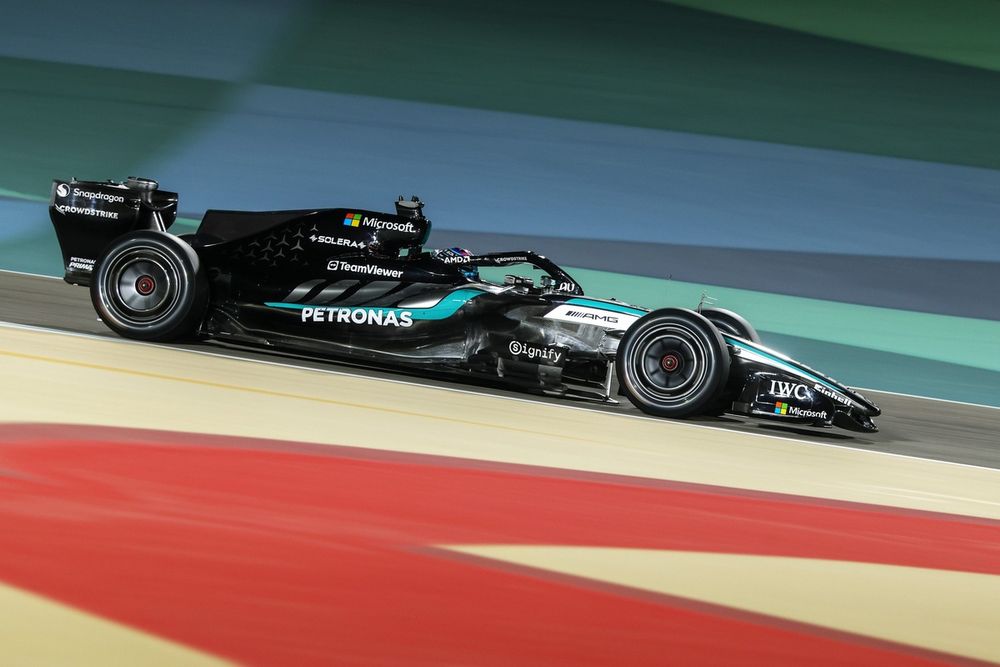
George Russell, Mercedes
Picture by: Steven Tee / LAT Photographs through Getty Photographs
One other time period which has come up loads within the build-up to the 2026 season is ‘compression ratio’. That is the ratio between the quantity of the engine cylinder when the piston is on the backside of its stroke and the quantity when it’s on the high and for 2026, it was decreased from 18:1 to 16:1.
However it then emerged that Mercedes had discovered a loophole within the laws, referring to Article C5.4.3 which states {that a} static check at ambient temperature is the one methodology of measuring the ratio. So, the Silver Arrows discovered a solution to improve the compression ratio whereas the engine is operating, earlier than returning it to its regular state for when it is because of be measured.
This inevitably induced outcry although, with F1’s 4 different energy unit producers complaining that it offers Mercedes an unfair benefit. The German marque argued that it doesn’t however regardless, the matter has been settled with tweaks to how compression ratios are measured coming into power as early as 1 June.
Turbo lag
One other contentious subject with the 2026 laws is race begins, which are actually extra complicated because of the elimination of the MGU-H. That’s as a result of the MGU-H was the compression spinner which turned sizzling exhaust gases into electrical vitality and helped acceleration be instantaneous.
Now that it’s now not on an F1 energy unit, drivers should rev their engines a lot greater than earlier than and for some 10 seconds to spool up the turbo and overcome lag. Turbo lag is the delay between urgent the accelerator and receiving energy from the turbo.
So, timing the brand new process barely mistaken might have vital penalties by pitching the automotive into an anti-stall. Nailing race begins is due to this fact of larger significance this 12 months and might be a defining factor within the early rounds.
Sandbagging
One other side to regulate within the opening rounds of 2026 is who was sandbagging essentially the most in pre-season. In F1, sandbagging is when a crew or driver deliberately underperforms in testing to disguise their precise potential, as a result of in the event that they reveal every thing early on then rivals could resolve to repeat sure automotive elements. That clearly then takes away no matter benefit they’d labored on constructing in the course of the low season.
Sandbagging will be carried out by varied methods, whether or not it’s operating with extra gasoline, utilizing tougher tyres or drivers lifting off on objective.
We would like your opinion!
What would you wish to see on Motorsport.com?
Take our 5 minute survey.
– The Motorsport.com Crew
