

You hear it earlier than you see it – that’s the motto of the Ford Raptor T1+ on the 2026 Dakar Rally. On the coronary heart of the prototype lies a 5.0-litre Coyote Darkhorse V8 engine, that includes 32 valves, a bore of 93 millimetres and a stroke of 92.7 millimetres.
Through the use of a naturally aspirated engine, Ford is following a unique powertrain philosophy than its rapid opponents. The Dacia Sandrider makes use of a 3.0‑litre V6 engine with two turbochargers, and the Toyota Hilux is powered by a 3.4‑litre V6 – additionally with two turbos.
“Once we began designing the automotive, the rules have been nonetheless a bit totally different,” explains Joan Navarro, chief engineer at M‑Sport, in an interview with Motorsport.com. “This engine was initially meant for use with an air restrictor.
“At Dakar 2024, you have been nonetheless allowed to compete with a naturally aspirated engine and restrictor. However after Dakar, after we started testing, the foundations modified, that means we needed to set up a torque sensor like everybody else.
“So, we needed to adapt, for the reason that automotive was already completed and we didn’t have time to fully redesign it. However as soon as we noticed the outcomes and did loads of testing, we discovered that it truly labored very well.”
With the torque sensor, the FIA screens a prescribed torque curve, successfully equalising efficiency throughout autos. The highest pace of all T1+ vehicles is restricted to 170 km/h. Underneath these parameters, the naturally aspirated V8 engine has no drawback in comparison with the smaller turbo engines.
Among the many frontrunners, Ford was the one producer to obtain minor time penalties for barely exceeding the torque curve. The one different case concerned the non-public Toyota of Michal Goczal.
“On the engine facet, there are not any main variations,” says Navarro, who sees the sector as properly balanced. “Throttle response is sweet. I’m unsure whether or not it’s higher or worse than the others, nevertheless it’s good.
“One other necessary issue is simplicity and reliability. That’s the most important benefit of this engine. You don’t have an intercooler or a turbo, you generate much less warmth, cockpit temperatures are decrease, and every thing is easier.
“The engine is extra strong than a turbo, and since reliability is extraordinarily necessary at Dakar, that was the primary cause.”
Cooling and aerodynamics, which guarantee optimum airflow by way of the automobile, are among the many most complicated points of a Dakar automotive.
Ford M-Sport group space
Photograph by: Pink Bull Content material Pool
Cooling as a significant problem
Computational Fluid Dynamics (CFD) evaluation is the primary technique used to review and optimise cooling for various working situations, together with various ambient temperatures.
“Aerodynamic drag and downforce aren’t that necessary to us as a result of we solely attain 170 km/h at most, and more often than not we’re going 60 or 80,” Navarro explains. “So we’re truly gradual. At 60 km/h, drag is hardly a difficulty as a result of it’s so low.
“However cooling at these speeds can also be very restricted, so that you want an excellent system since not a lot air flows by way of the automotive. The ducts and every thing must be positioned extraordinarily properly. That’s the place we put in a whole lot of work.”
The dunes, specifically, are an enormous problem. Speeds are low, but to maneuver ahead within the sand, the motive force should keep on the throttle. The engine runs at excessive revs, and temperatures improve dramatically.
“Common pace within the dunes is about 40 km/h, and also you’re at full throttle, since you want way more energy within the sand. That’s the worst‑case situation: low pace and excessive power demand. The system design actually must be spot‑on.”
No gas difficulty regardless of 5 litres of displacement
The utmost gas capability for a T1+ automotive per stage is 500 litres. You may count on a 5‑litre V8 with out compelled induction to be excessively thirsty, however that’s not the case with the Ford Raptor.
“For those who ran this engine with none limits, I feel it might produce round 500 horsepower,” Navarro says. However that theoretical determine isn’t attainable in observe as a result of mandated torque curve.
“Whenever you limit the ability, the gas consumption isn’t that prime. It could be if it ran unrestricted. However at this low output – round 268 or 270 kilowatts, so below 400 horsepower – the engine isn’t working arduous and doesn’t use a lot gas.”
The diminished energy output can also be why the Raptor has just one exhaust as an alternative of 1 per cylinder financial institution.
“If the engine have been unrestricted, it will make sense to have two. However with the present energy restrict, we run a single one as a result of it’s less complicated,” Navarro explains.
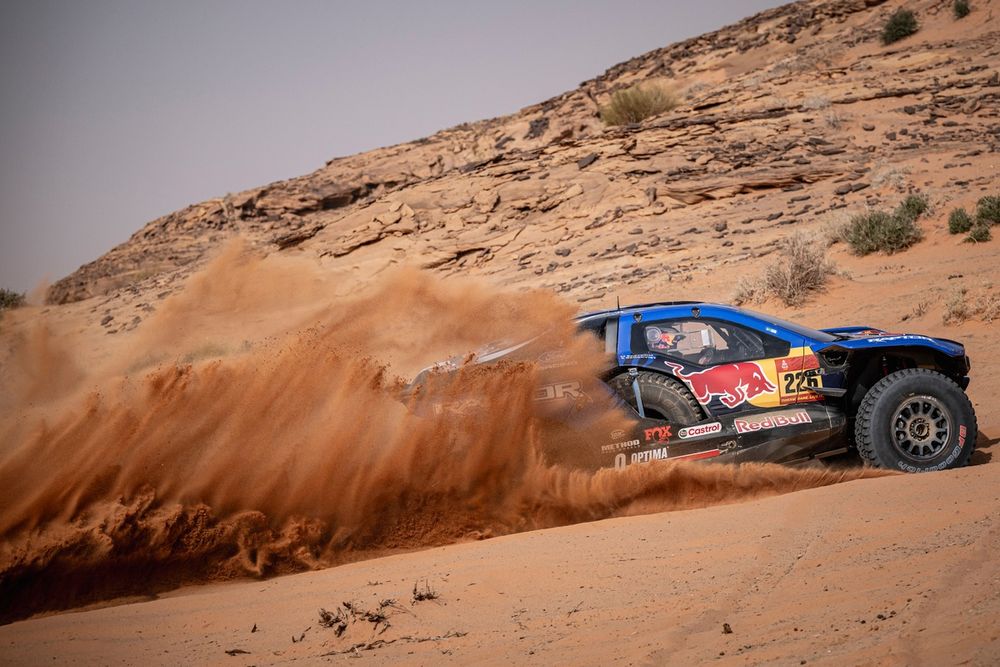
#226 Ford M-Sport Ford: Mattias Ekstrom, Emil Bergkvist
Photograph by: Pink Bull Content material Pool
Why Ford makes use of Fox dampers
M‑Sport develops and builds your complete Raptor at Dovenby Corridor within the UK. The engine and gearbox are additionally assembled in these historic services. However Ford is taking its personal path not solely in engine alternative but additionally in suspension.
Whereas most opponents use Reiger dampers, Ford employs merchandise from Fox. At first, the group wasn’t positive whether or not this might be the proper resolution, however early testing proved it to be a sensible transfer.
“We all know Fox has a very sturdy background within the US,” Navarro notes, pointing to Baja racing in California. “We simply weren’t positive how they’d carry out when it comes to traction, cornering, and rally‑type dealing with, since Dakar is a mixture of each.
“So, we did a whole lot of testing and ultimately noticed that they labored very well. We selected them as a result of they really carry out higher. We’re actually proud of them. There are two shocks per wheel, every working fully independently.”
Concentrate on weight discount
Ford enters the Dakar Rally for the second time as a manufacturing unit group in 2026. On its debut in 2025, the group gained two levels, and Mattias Ekstrom completed third general. Over the previous twelve months, the automotive has undergone quite a few element modifications beneath the bodywork.
On one hand, the group labored intently with Fox on suspension improvement; on the opposite, it centered on lowering general weight to get nearer to the two,010‑kilogram minimal requirement.
“Whenever you construct a primary‑era automotive – and this is applicable to each producer – it all the time finally ends up heavier than anticipated. You lose efficiency due to that,” Navarro explains, declaring the straightforward cause: “You play it secure.
“Within the first 12 months, you don’t need to threat breaking down; you simply need to accumulate mileage. So that you over‑engineer every thing, make elements a bit stronger than crucial. Our primary precedence this time was weight discount.
“Precedence two was fixing all the issues we had – element failures, harm, upkeep points, and so forth. And the third matter was engine efficiency.
“As I mentioned, we constructed the unique automotive for a restrictor setup, so we needed to adapt and spend many hours ensuring the electronics labored correctly. These have been the three most important areas.
“Then there have been a whole lot of smaller ones, just like the dampers – we made a giant step ahead with the suspension and a number of other different small enhancements.”
The up to date model of the Raptor is internally known as “Evo.” A complete of seven vehicles from Ford are competing in Saudi Arabia, three greater than within the first 12 months.
We wish your opinion!
What would you prefer to see on Motorsport.com?
Take our 5 minute survey.
– The Motorsport.com Group
